Academia has its own language. On the surface, it sounds polite, thoughtful, and collaborative. In reality, it’s a carefully evolved dialect designed to survive meetings, peer review, and email threads that never end. Here’s a quick translation guide.
Peer Review, But Make It Passive-Aggressive
Peer review is how science moves forward. It is also how Reviewer #2 moves the goalposts.
“The contribution is unclear.”
→ I did not read this carefully.
“The paper lacks novelty.”
→ I personally would not have done it this way.
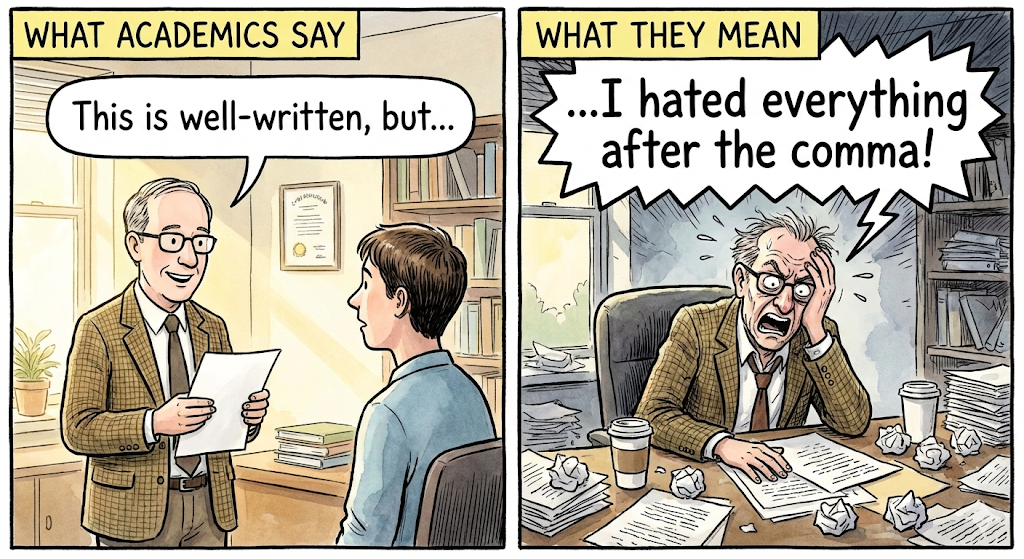
“This is well-written, but…”
→ I hated everything after the comma.
“The authors should cite relevant prior work.”
→ My papers.
“Major revision.”
→ Start over, but keep the title.
“Reject.”
→ Rewrite your life choices.
“The method is too simple.”
→ I don’t understand it.
“The method is too complex.”
→ I don’t understand it.
“The experiments are insufficient.”
→ Add three months of work, but I know the editor will give you only three weeks.
“The evaluation is not convincing.”
→ The results disagree with me.
“This is incremental.”
→ I thought of this once in 2009.
“The writing needs improvement.”
→ I skimmed the abstract.
“The assumptions are unrealistic.”
→ Reality is inconvenient to my theory.
“The paper would benefit from a stronger theoretical analysis.”
→ Please derive something painful.
“The paper would benefit from more real-world experiments.”
→ Please acquire a new dataset, infrastructure, and funding.
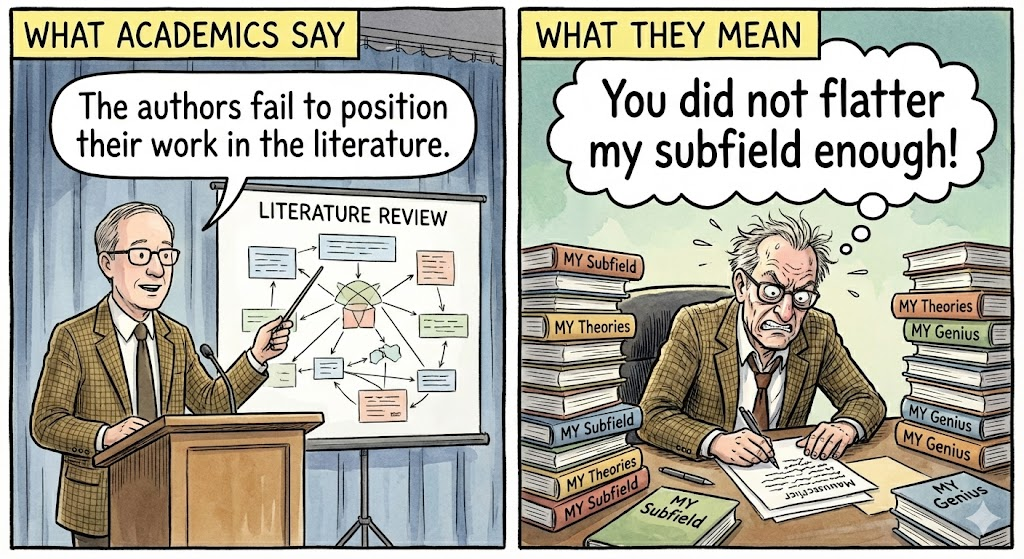
“The authors fail to position their work in the literature.”
→ You did not flatter my subfield enough.
“I am not convinced the problem is important.”
→ It is not my problem.
“The rebuttal did not address my concerns.”
→ I did not read the rebuttal.
Babysitting Students
Being a professor sometimes means doing more than teaching. It means managing, guiding, and occasionally babysitting students who didn’t read the instructions, the syllabus, or reality itself. Here’s the unofficial translation.
“Have you tried reading the syllabus?”
→ I will answer this 17 more times before lunch.
“Check the lab manual.”
→ I wrote it, but you still won’t read it.
“Please ask your TA.”
→ I am done being helpful today.
“It’s in your assignment instructions.”
→ You literally ignored it.
“Remember to backup your work.”
→ You will regret not doing this.
“Group work is a learning experience.”
→ Someone will cry.
“Make sure you follow the protocol.”
→ I will spot-check, and you will panic.
“Office hours are for you.”
→ Unless I’m busy, then it’s for me.
“You can do this independently.”
→ I will regret saying this.
“You should take the initiative.”
→ But don’t actually fail.
“Learning is a process.”
→ Mostly a test of patience.
“Don’t hesitate to reach out.”
→ I will hesitate for you.
Conference Room Dialect
The following language is spoken fluently in windowless rooms with bad coffee, especially by deans, department chairs, and the like.
“Let’s take this offline.”
→ Please stop talking.
“This will only take five minutes.”
→ Cancel your afternoon.
“We’ll circle back to that.”
→ This will die quietly.
“We’ll form a small working group.”
→ This will never meet, or it will meet forever.
“Let’s be mindful of the timeline.”
→ Can you please stop talking and just get it done?
“Let’s stay high-level.”
→ Details will expose problems.
“Can you send a quick follow-up?”
→ Please document this chaos.
“We need more stakeholders involved.”
→ Add three more meetings.
“We need consensus.”
→ Do you hear what you say?
“Let’s socialize this idea.”
→ Prepare for meetings without outcomes.
“This is a complex issue.”
→ I don’t want to deal with it.
“We’re running short on time.”
→ You are still talking.
“Let’s not get into the weeds.”
→ The weeds are the problem.
“Let’s table this for now.”
→ Never again.
“Can we take this as an action item?”
→ Someone else should suffer.
“Let’s hear from someone who hasn’t spoken yet.”
→ Please save us.
“We need to be realistic.”
→ Lower your expectations.
“Let’s capture that.”
→ Write it down so we can ignore it later.
“We’re making good progress.”
→ Nothing happened.
“Let’s double-click on that.”
→ I want to sound useful.
Administrative Petry
A language optimized for meetings, metrics, and avoiding responsibility.
“There are budget constraints.”
→ No.
“We’re exploring several options.”
→ We’re delaying a decision.
“We’re in the process of updating the policy.”
→ Nothing will change.
“We should align on expectations.”
→ Someone is about to be disappointed.
“This aligns with our strategic priorities.”
→ Someone powerful likes it.
“We’re very excited about this initiative.”
→ A consultant suggested it.
“We need to be data-driven.”
→ I already decided.
“This will reduce faculty workload.”
→ It will add a new form.
“We’re streamlining the process.”
→ New portal incoming.
“This is about student success.”
→ It sounded like something that would make me look good. I expect you to figure out the details.
“We encourage innovation.”
→ After three committees approve it.
“We’re piloting a new platform.”
→ You are the pilot.
“This will improve efficiency.”
→ You will do more for free.
“We need to think big picture.”
→ Your problem is inconvenient.
“This is best practice.”
→ Another university did it.
“We’re building a culture of excellence.”
→ Please update your annual report.
“We’ll provide training.”
→ There will be a PDF.
“This is a compliance issue.”
→ Do it or else.
“We’re here to support faculty.”
→ From a distance.
“This is an exciting time for the university.”
→ Something expensive just happened.
Professional Friendliness (Terms and Conditions Apply)
Academia runs on kindness, collaboration, and carefully worded lies.
“That’s a great point.”
→ I already decided not to change anything.
“This is an interesting question.”
→ I have no idea, but I respect your confidence.
“We should definitely collaborate sometime.”
→ I will forget your name in 12 minutes.
“Let’s stay in touch.”
→ Goodbye forever.
“I’ll follow up with you.”
→ I will not.
“Feel free to reach out anytime.”
→ Please don’t.
“I’ll take a look when I get a chance.”
→ This is your problem, not mine.
“Happy to chat!”
→ For exactly 15 minutes.
“I’ll loop you in.”
→ You will be CC’d into chaos.
“Sorry for the late reply.”
→ I saw this last week.
“Just circling back.”
→ I am quietly judging you.
“Great to e-meet you.”
→ I already forgot your face.
“Let me think about it.”
→ No.
“That’s outside my expertise.”
→ I don’t want to be involved.
“I’ll defer to others on this.”
→ Not touching this.
“Let’s touch base next week.”
→ This will be rescheduled twice.
“Sounds good to me.”
→ I did not read this.
“With all due respect…”
→ Prepare to be disrespected.
“No worries at all!”
→ There are worries.
Leave a Reply