Administrative bloat is getting out of hand. Over the past decade, I’ve watched job titles multiply like bacteria in a petri dish: Associate Dean of This, Vice Provost of That, Senior Executive Director of Strategic Alignment and Synergy (okay, slight exaggeration—but not by much). Meanwhile, class sizes creep upward, faculty searches get “paused,” and research time evaporates into a fog of meetings and compliance forms.
This isn’t just grumpy nostalgia. It’s a structural shift in how universities operate, and it’s quietly reshaping academic life in ways that are bad for teaching, bad for research, and most importantly, bad for students.
The University That Learned to Love Managers
Babyboomers and Gen Xers, please allow a millennial to talk about the good old days. Well, universities used to be simple organizations:
- Faculty taught and did research.
- Students learned.
- Administrators handled logistics.
Somewhere along the way, the balance flipped.
Today’s university increasingly resembles a mid-sized corporation whose main product is process. Teaching and research still exist, but they orbit a growing administrative core that manages, evaluates, audits, reports, strategizes, re-strategizes, and re-reports on the management itself—exactly what we call administrative bloat.
You can see this in:
- The explosion of associate and assistant deans
- Multiple layers of provosts and vice provosts
- …and their senior advisors
- …and their assistants
- Entire offices dedicated to “assessment,” “compliance,” “student success,” “strategic initiatives,” and “institutional effectiveness”
- All those DEI positions (there, I said it)
None of these roles is inherently evil. Many are filled by competent, well-intentioned people.
Also, don’t get me wrong. I’m not against the values on the surface, like “compliance,” “effectiveness,” “student success,” “divergence,” and “inclusion.” These are core values that academia should definitely pursue, and there is no doubt about it.
The problem, instead, is scale.
The Numbers Tell an Awkward Story
If administrative bloat in universities feels like an anecdote more than a pattern, the numbers say otherwise. And they’re surprisingly blunt.
Administrative Roles Have Grown Faster Than Faculty and Students
Over the long run, colleges and universities in the U.S. have expanded administrative employment far more rapidly than the core activities of teaching and research. Between 1976 and 2018, the number of full-time administrators at American colleges increased by 164%, and the number of other professional staff (non-faculty but non-administrators) rose by 452%. By comparison, full-time faculty grew by only 92%, while student enrollment increased 78% over the same period [Forbes].
In practical terms, this means that administrative ranks have ballooned much faster than either the students they serve or the professors who educate them.
Administrators Now Often Outnumber Faculty
At some institutions, administrators have become a dominant presence:
- Harvard’s administration grew 43% from roughly 5,300 full-time administrators to more than 7,500 in recent years, while faculty, starting at 2,000 faculty members, increased only 11% in the same span [The Harvard Crimson].
- At Yale, administrators and managers exceed the number of undergraduate students: a striking reversal from traditional staffing models [The Bowdoin Review].
- Case studies from multiple universities show administrator-to-faculty ratios as high as 6.9 administrators per faculty member at Harvard and 3.1:1 at Auburn by 2023 [Ramos, 2025].
These ratios are not isolated to just a few schools; they reflect a systematic shift toward greater administrative staffing relative to teaching roles.
Faculty Per Administrator Has Fallen Sharply
The ratio of faculty members per administrator has fallen over the past few decades. In the early 1990s, there were significantly more faculty relative to administrators; by the early 2010s, that ratio had dropped by roughly 40%, with faculty averaging only 2.5 per administrator at many U.S. institutions, creating a stark contrast to earlier eras when teaching staff far outnumbered bureaucrats [College Planners of America].
Cost Trends Reflect These Shifts
Increasing administrative employment has also shown up in spending patterns:
Between 1993 and 2007, inflation-adjusted administrative spending per student grew by 61%, while instructional spending increased only 39%, suggesting more money is going toward “management layers” than toward classroom instruction [Goldwater Institute].
What Do All These Deans Actually Do?
Let’s be honest: some administrative work is essential.
Payroll matters.
Legal compliance matters.
Facilities matter.
But a growing share of modern academic administration is devoted to:
- Creating symbolic compliance roles to manage reputational risk rather than materially improving student outcomes (= what I call “institutional airbags” deployed to absorb impact when controversy hits, not to steer the vehicle, e.g., many of the DEI positions.)
- Translating information between incompatible software systems
- Measuring things that are only loosely related to learning
- Producing reports for other administrators to read
- Coordinating meetings about meetings
- Designing procedures to manage the side effects of earlier procedures
Each title and role individually may sound reasonable and good-faithed. In job descriptions and organizational charts, they read like signs of a caring, carefully managed institution.
Collectively, however, they form something else: an expanding administrative atmosphere that faculty and students must constantly breathe. It fills calendars, inboxes, and mental bandwidth; It adds friction to simple tasks and complexity to basic decisions; It slowly converts time meant for teaching, learning, and thinking into time spent navigating the institution itself. Yet, nothing gets done.
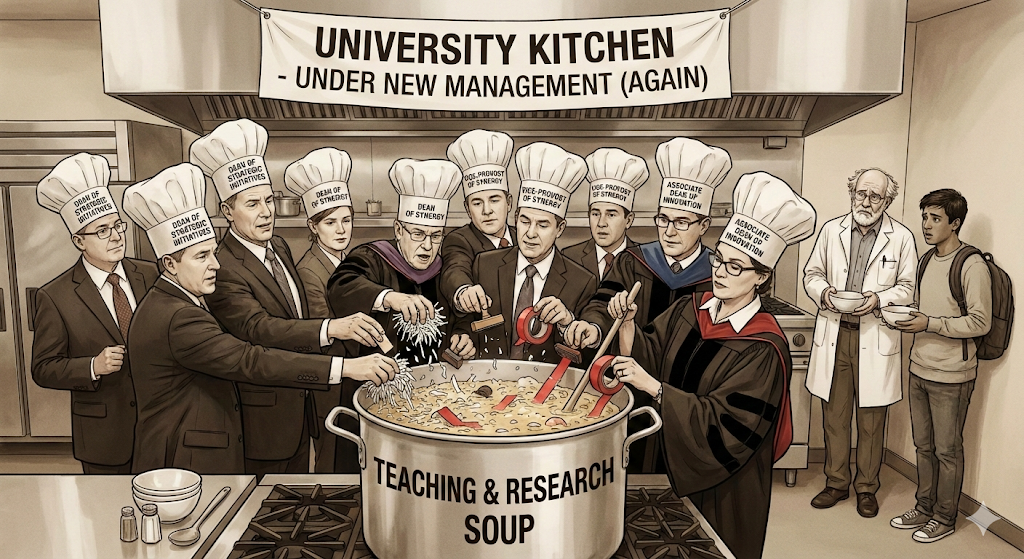
No single dean spoils the broth.
But enough of them will.
The Real Cost: Academic Productivity
The damage of administrative bloat isn’t primarily financial, although administrative salaries are not cheap.
The real cost is academic productivity.
Every new administrative layer creates:
- New forms
- New reporting requirements
- New training modules
- New meetings
- New software portals
- New deadlines
All of this draws from the same finite resource: human attention. And all of us know that these are not meant for academic productivity (or any actual meaningful change). These are mostly meant for a liability ping-pong.
Faculty time is not infinitely divisible. Every hour spent on compliance paperwork is an hour not spent:
- Preparing lectures
- Advising students
- Writing papers
- Building experiments
- Thinking deeply
Universities often talk about “supporting faculty productivity.” In practice, they frequently construct elaborate systems that consume it.
Why Administrative Bloat Keeps Happening
Administrative bloat isn’t the result of a single bad decision. It emerges naturally from modern incentives:
- Risk Aversion: Universities fear lawsuits, accreditation penalties, and bad press more than inefficiency. So they hire.
- Quantification Addiction: If something can’t be measured, it doesn’t exist to management. So they hire people to measure it.
- Funding Structures: Overhead from grants rewards larger administrative infrastructures. So they expand.
- Prestige Signaling: Complexity masquerades as sophistication and prestige. So they add titles.
- No Market Discipline: Universities don’t go bankrupt when inefficient. So nothing forces simplification.
“But These Are Good People”
They are.
This is not a moral critique of administrators.
It’s a structural one.
A system can turn competent, ethical people into full-time maintainers of institutional friction. Many administrators privately admit that much of their job consists of navigating problems created by other administrative processes.
The system turns intelligence into middleware.
What a Healthier University Would Look Like
Imagine a university that:
- Defaults to trust, not documentation
- Audits randomly instead of universally
- Uses one or two well-designed systems instead of twelve broken ones
- Treats meetings as a cost, not a virtue
- Measures learning directly, not bureaucratically
- Hires administrators primarily to remove work from faculty, not to create new workflows
Radical ideas, apparently.
Too Many Deans, Too Little Thinking
Universities don’t need more:
- Strategic initiatives
- Leadership retreats
- Vision statements
- Assessment frameworks
- Inclusion specialists
They need:
- Fewer forms
- Fewer layers
- Fewer portals
- Fewer titles
- Fewer cooks
And fewer sayings, but more actions.
No amount of committees, committees-about-committees, or symbolic offices will teach a class, help a student, or produce knowledge.
When too many deans run the kitchen, nobody has time to cook.
Leave a Reply