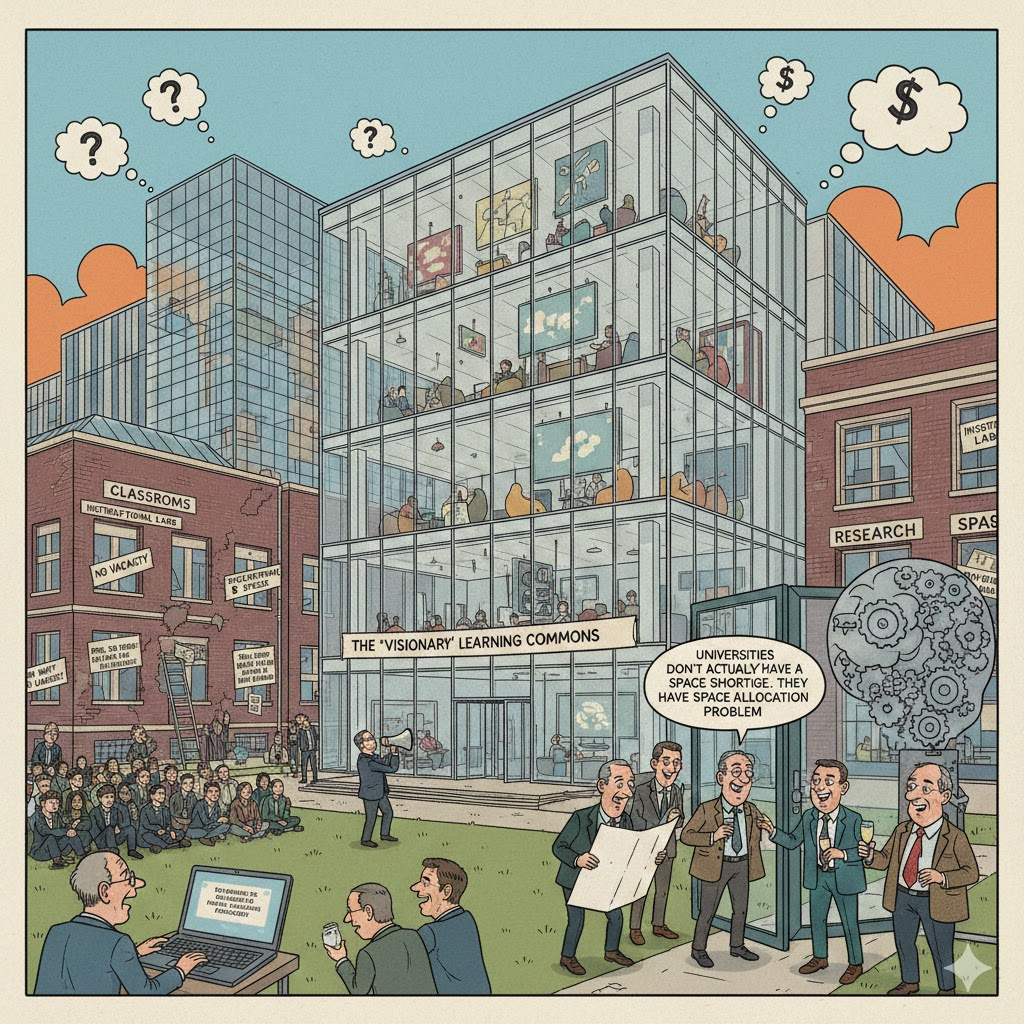
I sit on a ‘faculty building committee’ whose stated purpose is to “provide faculty input” on a new campus building. Space shortage is everywhere in academia, and my university isn’t an exception.
Listening to other faculty and student colleagues, the message is simple:
We need more classrooms, more instructional labs, and more research spaces.
But after months of meetings, what keeps coming back are:
Souring glass walled atriums, open lounges, and “collaboration hubs.”
Why does this happen?
And how can we feel perpetually out of space when campuses keep expanding?
The answer is structural. And the publicly available data supports it.
The Myths About Space Growth
Myth #1: “Universities Are Out of Space Because Enrollment Is Exploding”
At research universities (R1s), total enrollment has grown modestly over the past decade, roughly 13% increase between 2010 and 2022, according to IPEDS / NBER data [Vigdor, 2024]. At other non-R1 institutions, total enrollment has actually declined somewhere between 7.5% to 28% over the same period, according to the same data.
Meanwhile, campus space continues to expand. Data from Sightlines show that higher-ed campus space increased about 16% between 2007 and 2021 across U.S. and Canadian institutions. A recent industry survey found that ~65% of colleges reported having construction planned over the next few years, up from 60% previously. The same survey reports that the average construction budget for colleges in 2025 was ~$34 million. Investment in existing campus buildings has also increased by over 26%, according to Higher Ed Dive.
Bottom line? The campus isn’t suddenly overcrowded because thousands of new students arrived overnight. Enrollment growth is gradual and generally tracked by campus expansion.
Myth #2: “If Classrooms Are Full, We Must Need More Classrooms”
Classroom utilization studies reveal that many teaching spaces are actually underused. For example, UNC system campuses report that classrooms average ~22.6 hours per week of use and instructional labs ~13 hours [Vedder, 2025].
This means bottlenecks often appear during peak hours, while significant unused capacity exists at other times. The problem isn’t always the number of classrooms. It’s scheduling inefficiencies and allocation policies.
Myth #3: “Most Campus Space Is for Teaching and Research”
Data from multiple university systems show that classrooms and instructional labs occupy only a small fraction of total campus space. For example, according to California’s Legislative Analyst’s Office, 2025:
- University of California: classrooms + labs ≈ 10% of state-supportable spaces (=generally include classrooms, instructional and research laboratories, faculty and administrative offices, and libraries).
- California State University: classrooms + labs ≈ 25%.
The rest of the space goes to offices, student services, residential halls, and amenity spaces. Expanding the campus footprint doesn’t necessarily expand core academic capacity.
Myth #4: “Open Collaboration Areas Can Replace Offices and Labs”
Modern architectural trends favor open lounges, collaboration hubs, and innovation commons. Administrators often count this as usable academic space, but in practice:
- These areas cannot host experiments, store equipment, or support confidential meetings.
- They cannot be scheduled like classrooms or labs.
Such spaces increase campus square footage without increasing the functional capacity for teaching or research.
Myth #5: “Buildings Are Always Driven by Academic Need”
The evidence suggests otherwise. Institutions frequently build prestige-oriented structures, like soaring glass atriums, administrative offices with ornamental fireplaces and expensive conference tables, fancy recreational facilities with huge climbing walls or yoga mats, and donor-named hubs, even when enrollment is flat [Vedder, 2025].
These projects signal institutional ambition and attract donors, but they often do little to relieve day-to-day academic bottlenecks.
Why This Keeps Happening
The pattern you see—faculty ask for classrooms and labs, and the plan returns with glass walls and lounges—isn’t random. It’s structural, driven by the incentives and decision-making frameworks in higher education:
- Risk Aversion Among Leadership
University administrators and boards rarely want to make decisions that could be unpopular (check out my other post on this: Too Many Deans Spoil the Broth). Large, flashy, multipurpose spaces are politically safe: they look good in reports and photos and signal “modernization”; while investing in utilitarian classrooms and labs is less visually impressive and harder to sell to donors or the public. - Donor Influence and Prestige Culture
Many new buildings are funded partially or fully by donors who want their name on a high-profile, architecturally striking building. These donations skew space allocation toward prestige over pedagogy, even when internal data shows the urgent need is for instructional space. - Planning Metrics and Reporting Bias
Campus planning often counts square footage, not functionality. A 10,000-square-foot lounge can inflate total campus space metrics and make administrators appear responsive, even if actual classroom and lab capacity hasn’t increased. In other words, reporting can mask the mismatch between growth and core academic needs. - Incentive Misalignment
Faculty want functionality; leadership wants optics. Architects want signature designs; planners want to demonstrate compliance with codes and “innovative design standards.” The result is a system where the people closest to the educational mission are often the weakest in the decision-making hierarchy.
The Paradox of Being “Out of Space”
Even when total campus square footage grows faster than enrollment, the experience of scarcity persists. Why?
- Misallocated Growth: Most new square footage is allocated to offices, student services, recreational or prestige spaces, not instructional or research capacity.
- Peak-Time Bottlenecks: Classrooms and labs may sit empty outside peak hours, creating the perception of scarcity during the critical times they are actually needed.
- Functional vs. Symbolic Space: Spaces that look “big” and modern are often symbolic rather than functional, boosting campus prestige without easing faculty or student workloads.
In short: campuses are technically growing, but not in ways that solve the bottlenecks that faculty and students actually care about.
What Faculty Can Learn from This
- Demand Data-Driven Allocation
Advocate for utilization metrics, classroom/lab per student ratios, and lab-to-faculty ratios rather than just total square footage. Numbers are harder to ignore than aesthetics. - Engage Early with Donors
Faculty can influence design by participating in donor conversations, ensuring that donated funds support functional spaces first. - Reframe the Conversation
Instead of asking for “more classrooms” generically, show how the lack of specific spaces impedes research, teaching, or student outcomes. Concrete examples cut through administrative buzzwords.
Conclusion: The Space Illusion
Universities keep expanding, yet faculty feel constantly “out of space.” The data is clear: we aren’t running out of buildings because of enrollment surges; total campus space is increasing, often faster than enrollment growth outside of R1s.
The problem is what kind of space is being added, who decides, and how incentives are structured. Luxurious atriums, collaboration lounges, and donor-facing hubs may make the campus look modern, but they do little to reduce actual academic bottlenecks.
Space isn’t scarce. Good space planning is.
답글 남기기